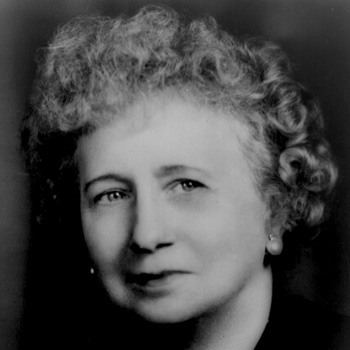
Elizabeth Virgina "Bess" Truman
Bess Truman had never wanted to be the Vice President's wife, let alone the President's wife. There was nothing about being recognized by strangers or superficial adulation that she found flattering. According to her daughter, however, Bess Truman's fear of public knowledge of her father's suicide was the primary reason she insisted on maintaining a low public profile. In the 1940s there still remained a stigma attached not only to the memory of the individual who had taken their own life but also to their surviving family members.
Several incidents in her first year as First Lady solidified Bess Truman’s instinctive determination to avoid press coverage or more than the most obligatory of public appearances and ceremonial tasks. Just after the official mourning period for President Roosevelt ended in May of 1945, during what was her first sound and motion picture recorded event as First Lady and soon after seen by millions of Americans in theater newsreels, Mrs. Truman realized how little control a public figure can have over the persona the mass media might convey of them.
HDuring Bess Truman’s first year as First Lady one incident had the potential of creating a political controversy. In the autumn of 1945 she accepted an invitation to attend a tea hosted by the Daughters of the American Revolution, seemingly oblivious to the potential controversy doing so might cause, given the organization’s adherence to the city’s racial segregation edict and banning of any but white performers in its Constitution Hall performance center. The incident might not have generated as much attention as it did had it not been for the fact that, after the First Lady had accepted the invitation, the African-American jazz pianist Hazel Scott had been refused use of the hall for a public concert and the fact that she also happened to be married to the powerful African-American Congressman Adam Clayton Powell.
Throughout her eight years as First Lady, Bess Truman sponsored charities and causes associated with First Ladies, by opening fairs and sales, or accepting honorary membership or title of honorary chairmanship. She would greet leaders of various voluntary organizations in the White House and pose for photographs that were released to the press, or attended a charity luncheon as a headliner whose presence had helped to sell tickets. Bess Truman did not have a particular demographic she chose to support but while she did not limit herself by the intention of any specific social problem, all were organizations intended to provide funding for the financially disadvantaged or living with physical challenges. She continued the Roosevelt fundraising efforts for the March of Dimes, which sought to eradicate polio, and provided consistent support for organizations including the Community Chest, the Salvation Army, the Girl Scouts, the Red Cross and Cerebral Palsy.
Whenever they were apart, Harry Truman wrote detailed and affectionate letters to his wife, giving her inside observations and political assessments of figures such as England's Prime Minister Winston Churchill and Soviet leader Joseph Stalin. She evidently destroyed any of her written responses. When they were both in residence in Washington, Bess Truman spent about two hours every evening with the president, reviewing his speeches, schedule and policy decisions. Precisely what advice she gave him or suggestions she made are speculative and uncertain, accountable only by the informed opinion of those close to them at the time, since there was no documentation generated when the couple was meeting together. It is known that she dismissed widespread speculation that he would name a prominent editor as his press secretary, and successfully recommended that he instead name their former schoolmate Charlie Ross, St. Louis Post-Dispatch Washington editor. There is circumstantial evidence that she also sought to use her influence with the President to intervene on behalf of individuals who appealed to her for help in dire situations, as illustrated in one letter to a Charlie Tucker seeking to have a friend and his wife safely returned from a threatening but unspecified international situation; her letter also suggests Tucker helped facilitate installment of a controversial freezer she was given.
Bess Truman provided reliable, informed and professional advice that gave the President confidence in his decisions to initiate monumental postwar foreign policy. Circumstances placed Harry Truman in the role of making some of the most momentous global decisions of the twentieth century. Truman declared to reporter Marianne Means in 1962, that he never made an important decision without first seeking the advice and reaction of his wife. Although their daughter would later claim otherwise, Truman affirmed to Means that he had consulted her on the dropping of the atomic bombs at Hiroshima and Nagasaki, Japan, which led to the Japanese surrender and end of World War II. Bess Truman later defended his decisions, affirming that it ultimately saved the lives of countless other Japanese and Americans from an otherwise expected land war.
In 1948, when it was learned that the old mansion was in danger of collapsing, the Trumans had to immediately vacate the premises. A debate ensued as to how best address the problem. There were some who suggested the house should be torn down and a new replica built in its stead. Bess Truman believed strongly that although it might be more expensive, it was important to preserve at least the four walls of the original house and have it serve as the shell for a modern, structurally sound presidential mansion.
The First Lady was visibly thrilled when, in March 1952, her husband publicly announced that he was retiring from politics and would not seek or accept his party’s nomination for what would have been only a second term of his own (having fulfilled FDR’s incomplete term from 1945 to 1949). She implored him against seeking another term, especially as Truman grew concerned during a brief period early in the election year that there was no credible Democratic candidate and wanted to reconsider his decision. Bess Truman's last month as First Lady was overshadowed by the final illness and death of her mother in the White House. The press and the public were never permitted to have a genuine glimpse of the character and personality of Bess Truman as First Lady. She remained sedate in appearance and cryptic in her few remarks. Only later, as accounts from White House staff, friends and family began to appear in print did her generosity, sensitivity and wit emerge for the public.