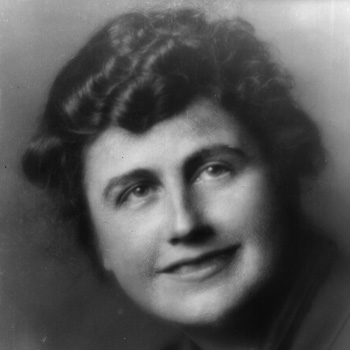
Edith Wilson
From the onset of her marriage to the President, Edith Wilson's primary role as First Lady was as his companion, filter and later guardian. Since most of her tenure occurred during either a presidential campaign - when the couple was not living in the White House- a world war and then during the president's illness, Edith Wilson hosted none of the entertaining at dinners and concerts held during the traditional social seasons in the fall and winter-early spring. That he largely conducted his work from a private office in the family quarters permitted Edith Wilson to remain steadfastly at his side; he soon gave her access to his private drawer and would eventually share a secret wartime code with her. When he worked from the Oval Office, however, she would often sit there listening silently as he conducted meetings with political leaders and foreign representatives. As pressures mounted on the President in the months leading up to U.S. entry in World War I, she began to screen his mail and limit his callers, soon alienating his most trusted advisor Edmund House and his loyal press secretary Joseph Tumulty. She was successful in eventually breaking the long friendship between Wilson and House, in November 1919.
One of the most dramatic chapters in presidential history unfolded in October of 1919 when Wilson suffered a debilitating stroke. Edith Wilson decided to somehow continue the Administration by conducting a disinformation campaign, misleading Congress and the public into believing that the President was only suffering from temporary exhaustion which required extensive rest. She became the sole conduit between the President and his Cabinet, requiring that they send to her all pressing matters, memos, correspondence, questions and requests. After deciding that Wilson should not resign and that Vice President Thomas Marshall should not assume even temporary responsibility, she began what she termed her "stewardship." Most crucially, she decided what she felt was important enough to trouble her husband about as he lay disabled in his sickroom. The result was often a confused response for the Cabinet, accompanied by their original papers with often-indecipherable notes in Edith Wilson's handwriting, which she claimed were verbatim notes she took of the President's answer to their questions. When the Secretary of State Robert Lansing conducted a series of Cabinet meeting without the President, the first being in October 1919, Edith Wilson considered it an act of disloyalty and pushed for his replacement with the more acquiescent Bainbridge Colby. Wilson requested Lansing's resignation in February 1920. As her husband began partially to recover, she also guarded access to him from advisors and other political figures. When Republican Senator Albert Fall was sent to investigate the President's true condition, Edith Wilson helped arrange Wilson in bed to be presentable and sat through the brief meeting, taking verbatim notes.
In September 1919, Edith Wilson refused to have the U.S. accept the credentials of British representative Edward Grey who had been sent by his government to aid in the push for ratification of Wilson's League of Nations unless Grey dismissed one of his aides who was known to have made demeaning jokes at her expense. As the liaison between Wilson and the Democratic Senator Gilbert Hitchcock (who was fighting in the Senate to make the President's case for passage of his League of Nations), Edith Wilson refused to press Wilson to accept the reality that without permitting a compromise of one plank the original version that it wouldn't pass at all. Historians have speculated whether, if Edith Wilson advised otherwise, a partial version of Wilson's League of Nations would have been attained. It was defeated in November 1919.