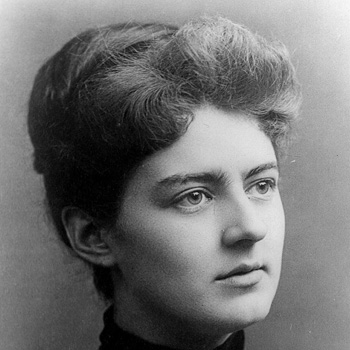
Frances Cleveland
The historic wedding of the only President and First Lady to wed in the White House attracted enormous international attention in the week and days leading up to the event, once it was learned that the President was not marrying his widow friend Emma Folsom but rather her 21 year old daughter. Reporters stalked every move of the bride as she made her way from New York to Washington, D.C. There were several newspaper stories every day on some aspect of the wedding, from a glimpse into the factory where the wedding cake boxes were being made to the types of gifts that were pouring in. On the day of the wedding, crowds gathered outside the mansion and could hear the strains of music played by John Philip Sousa who led the Marine Band. The entire house was festooned in flowers and the bride even wore a train trailed in orange blossoms. The guest list was limited to family, close friends, plus cabinet officers and their wives. Journalists were barred from the wedding (except for a last minute glimpse at the floral displays), and participants refused interviews. After the ceremony had ended, the entire city erupted with church bells pealing, ships blowing their horns and some well-wishers ringing hand bells.
Despite the President's best efforts "Frankie" (as she was called in the popular press, a nickname she disliked) became an instant celebrity. She was so mobbed by admirers at public events that the president feared for her safety.
Immediately after her wedding, the facial image of Mrs. Cleveland began appearing publicly for sale on a wide range of items. These fell into several types of categories. There were products such as ceramic tiles, sheet music, silver pill boxes, sewing kits, cigar boxes, candy, women’s perfume and even a tobacco pipe, which simply appropriated her image to adorn the objects being sold.
Frances Cleveland finally sought to consciously use her influence in ways that she considered more uplifting for her countrywomen. Perhaps the most pronounced and somewhat surprising were the receptions that she began to host on Saturday mornings, held especially for those working-class women who were unable to visit the White House during the weekdays. Some White House domestic staff members, such as Ike Hoover, were shocked as "common" shopgirls, government clerks, maids and other service industry workers lined up in the regal East Room to shake the hand and have a personal word with the popular young First Lady. When she attended a ceremony to mark the opening of an organization that provided for educational, social, and practical opportunities for factory workers and made a point of greeting women workers, it made the cover of the November 1887 Harper's Weekly magazine.
As a hostess, Frances Cleveland followed a more traditional manner; in fact, she took direct instructions from one of her predecessors, Harriet Lane Johnston, the niece and hostess to the last Democratic president to have been elected, bachelor James Buchanan. A Washington resident, Harriet Lane was a frequent guest at the White House and befriended Frances Cleveland. During her tour of the South with the President, Frances Cleveland also met with her elderly predecessor Sarah Polk at her Nashville, Tennessee estate, "Polk Place."
President Cleveland believed firmly that "a woman should not bother her head about political parties and public questions," and Frances Cleveland followed this sensibility by refraining from either learning the details of the issues he faced or the Administration agenda. Nevertheless, simply by the virtue of her popularity, Frances Cleveland was highly useful to her husband as a symbol of his Administration. On one occasion, in the midst of his 188 re-election campaign, she did make a highly heralded trip to the Capitol and preside from the visitors' gallery over a special session of Congress that the President had called to enact his proposal for a lower tariff. The Democratic National Committee, with the President's permission, also drew on her popularity for its own purposes. They inserted a pamphlet called, "Bride of the White House" into the literature it distributed to the party faithful as well as the politically undecided.