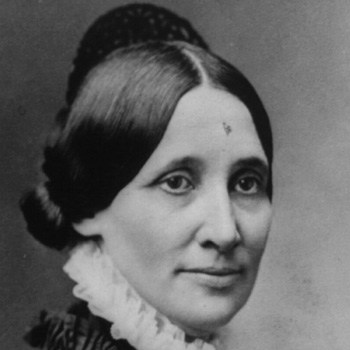
Lucy Webb Hayes
By the time her husband became President in 1877, Lucy Hayes had come to identify herself largely through the traditional roles of wife and mother. She considered her primary responsibility to be the education and care of her two youngest children, Scott and Fanny, six and ten years old, respectively, during their first year of living in the White House. However, as a woman of wealth able to afford domestic staff workers to maintain her home and help look after her children, she was not as pressed for her personal time as might be others who felt similarly.
With her strong sense of civic duty being a primary tenet of her Methodist faith, however, Lucy Hayes also believed that she had a larger responsibility to the world outside of her home and family. As First Lady, she seemed to expand this commitment nationally with relative ease. An important factor in her assuming a new level of public roles for a First Lady was also her pronounced personality, most often characterized as including a spontaneous warmth, charitable impulse, self-deprecating humor, and natural empathy.
With her popularity in the press and the fact that she was the first First Lady to have graduated with a higher education degree, there were high expectations for and pressures placed upon Lucy Hayes during her tenure, most especially from women activists advocating substantial temperance reform and passage of women’s suffrage.
A teetotaler since her youth, the First Lady strongly her husband’s decision – but she would nevertheless be ridiculed for the policy: caricatured on a wine bottle with a prudish expression, smiling in a water bottle. The nickname "Lemonade Lucy" cannot be specifically dated to the Hayes Administration, although there were anecdotes about her serving lemonade that was reddish in color and which she feared was wine until the President was posed as calming her that it was only a mashed berry in the lemonade. "Water flowed like wine," joked Congressman James Garfield, who was elected the succeeding President." She was nevertheless credited with giving temperance supporters enough courage to now publicly express their views and held up as a moral example for Ohio schoolchildren who read about her in their textbooks.
She took an especial interest in the efforts of the Native American tribe of Paiutes to have the federal government transfer them from forced detention in Washington territory to a preferred place in Oregon, yet despite the President’s attempts to do so, much of his power was limited by the U.S. Army and western congressmen. After a visit to the African-American Hampton College, the First Lady funded a scholarship for a Native American girl on the condition that she be permitted to receive her higher education there.
As popular a figure as she would become, Lucy Hayes was greatly appreciated in the community of severely poor in Washington, who lived in slum areas. On any occasion, when she was told of a case of a family or individual in dire need, Lucy Hayes would ask for the situation to be carefully investigated, and then directly aid with cash from her own account, or from money she insisted be collected from wealthy Cabinet members. In January of 1880 alone, the Hayes’s dispensed nearly one-thousand dollars, an enormous amount of money at the time. On a regular basis, she also sent flowers from the greenhouses to the local Children’s Hospital.
Her final days as First Lady were somewhat embittering. After having successfully avoided being exploited for the purposes of the Women’s Christian Temperance Union, she was initially wary though flattered by their national fundraising effort to commission a life-size portrait of her for the White House.
Her ambivalence towards the organization, however, was confirmed when she learned that only a small portion of the money they collected for the portrait was actually to be used for that purpose, the rest going for a temperance public relations campaign.