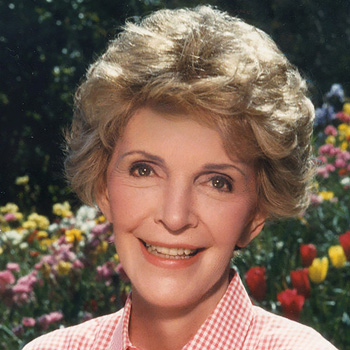
Nancy Reagan
When Nancy Reagan first became First Lady, her focus was on creating a home in the White House; rather than use government funds to redecorate as well as renovate the floors, doors and other hardware, she sought private funds to underwrite the work. In preparation for the required entertaining, she also carefully tested the meals that were to be served and also told U.S. New & World Report that she hoped to have new china ordered since there had been much breakage in the fifteen years since the Johnson set had been inaugurated. Rather than being purchased with federal appropriations, the cost of the new china set was entirely underwritten by the private Knapp Foundation. The combination of the redecorating, new china set, more formalized entertaining style than the Carters, in addition to her attendance at the royal wedding of Prince Charles and Princess Diana of England in 1981, and her acceptance of free clothing from designers (thus unwittingly violating the new Ethics in Government Act of 1978) led to the creation of a public relations dilemma. Contrasted in print and broadcast news with the 1981 economic recession, high unemployment and homeless families, the so-called "Queen Nancy" caricature was created and even occasionally invoked by Democrats as a means of criticizing the Administration. In addition, much as there had been some suggestion of a regional bias against LBJ's Texan background and the Carters' rural background in the national media, there was suggestion of one against the Reagans' southern California ties and entertainment industry careers.
Perhaps Nancy Reagan's largest and most important work as First Lady, was her role as the President's personal protector. Part of this role grew out of the March 30, 1981 assassination attempt on his life. Forever afterwards, Nancy Reagan made it her concern to know his schedule: in what public venues would he be speaking, before what groups, at what time, as well as with whom he would be privately meeting. In time, her concern to protect her husband's personal well-being led her to consult an astrologer to attempt to discern precisely what days and at what times would be optimum for safety and success, and which slots were to be avoided because of potential dangers as reflected in the astrological readings. Both Reagans admitted that the President had a tendency to trust all those who worked for him, while the First Lady tended to perceive those who, in her words, might "end run him," essentially using their positions to further their personal careers or agendas rather than that of the President and the Administration. The President's long-time aide Michael Deaver also served as a trusted and important advisor to Nancy Reagan and he often approached her when he felt a problem might be developing. Nancy Reagan effectively supported decisions to replace various personnel, including the likes of National Security Council member William P. Clark, and the hiring of others such as Secretary of State George Schultz.
Perhaps Nancy Reagan's largest and most important work as First Lady, however, was her role as the President's personal protector. Part of this role grew out of the March 30, 1981 assassination attempt on his life. Forever afterwards, Nancy Reagan made it her concern to know his schedule: in what public venues would he be speaking, before what groups, at what time, as well as with whom he would be privately meeting. In time, her concern to protect her husband's personal well-being led her to consult an astrologer to attempt to discern precisely what days and at what times would be optimum for safety and success, and which slots were to be avoided because of potential dangers as reflected in the astrological readings. Both Reagans admitted that the President had a tendency to trust all those who worked for him, while the First Lady tended to perceive those who, in her words, might "end run him," essentially using their positions to further their personal careers or agendas rather than that of the President and the Administration. The President's long-time aide Michael Deaver also served as a trusted and important advisor to Nancy Reagan and he often approached her when he felt a problem might be developing. Nancy Reagan effectively supported decisions to replace various personnel, including the likes of National Security Council member William P. Clark, and the hiring of others such as Secretary of State George Schultz.
Although Nancy Reagan rarely ventured into specific policy, it was she who defied the conventional wisdom in the Reagan Administration State Department to promote the idea of the President forming first a personal relationship with the new Soviet President Mikhail Gorbachev when he assumed power in 1985. She did so she recalled, simply because it made no sense to her that the two leaders were not at least in open dialogue with one another. The resulting friendship and then political negotiations resulted in the 1987 INF Treaty, which called for a mutual destruction of intermediate range nuclear missiles. The treaty proved to be a crowning moment for the Administration and was later considered by many to be an important step in the end of Soviet communism and the shift to democracy of several Soviet satellite nations. Nancy Reagan's devotion to seeing this through, as well as other aspects of her husband's legacy were made all the more dramatic in light of the fact that she underwent breast cancer surgery and shortly thereafter endured the death of her mother, all just prior to the treaty signing.